What's in the report
We ingested every publicly released CAT paper from 2017 through 2024 — 1,752 questions in total — and classified each one against Bloom's Taxonomy, Webb's Depth of Knowledge, topic and sub-topic from a CAT-specific taxonomy, difficulty band (1–5), and solution-path tags. Then we computed cross-year trends to identify stable patterns, drift vectors, and pivot years.
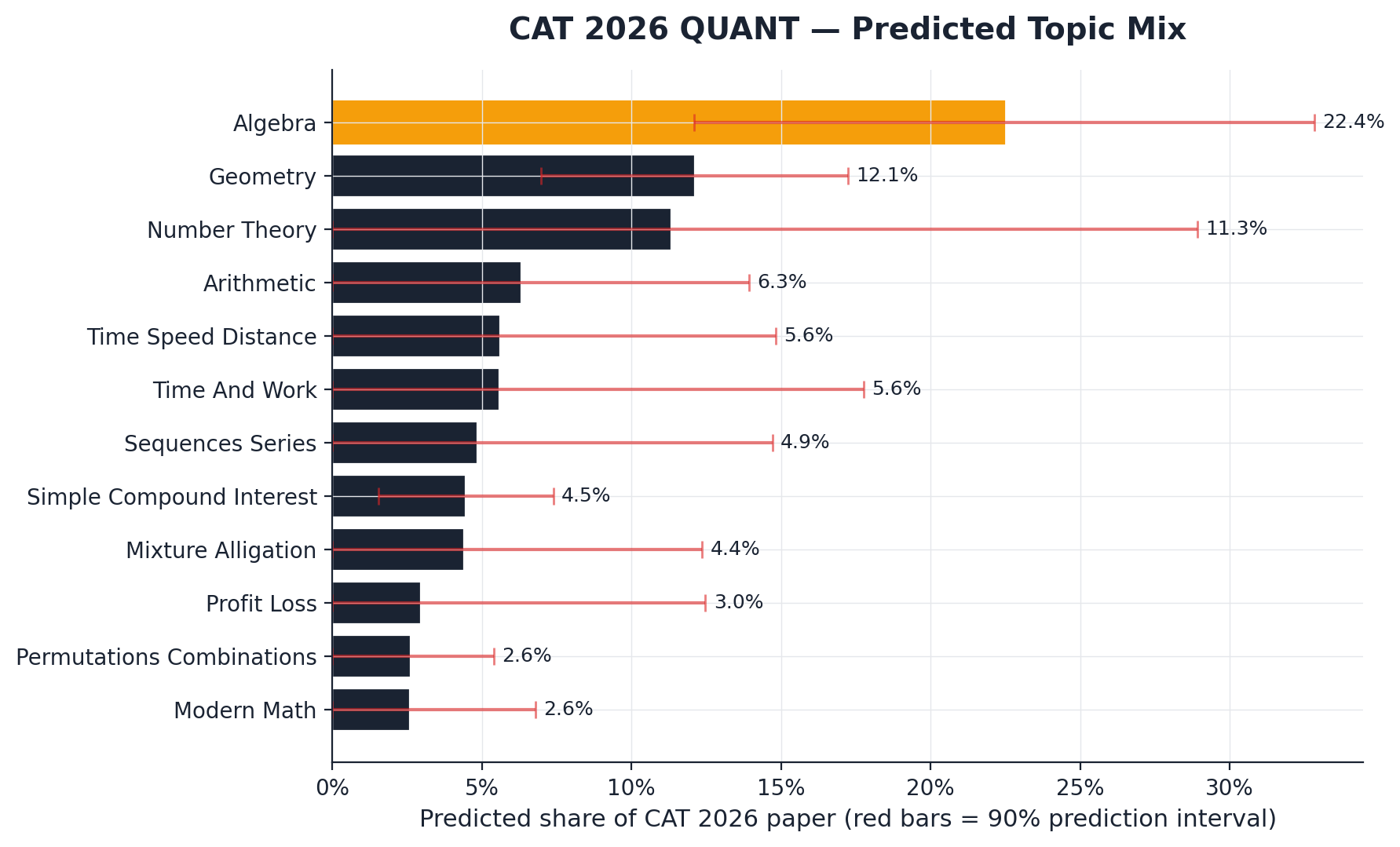
The headlines
- CAT 2026 Quant — Algebra projected at 22.4% (90% CI: 12.1% – 32.8%), Geometry 12.1%, Number Theory 11.3%. Difficulty mean 3.29 / 5. TITA ratio 34%.
- CAT 2026 VARC — Para-jumbles 17.7%, inference 15.8%, summary extraction 6.2%. Difficulty 2.78. TITA 9%.
- CAT 2026 DILR — Data-sufficiency 28.0%, caselets 25.4%, tables 15.3%. Difficulty 3.19. TITA 32%.
- Pivot stories — CAT 2022 Number-Theory share tripled (5.6% → 19.7%); CAT 2024 Algebra surged (17.6% → 26.6%); CAT 2020 Time-Speed-Distance spiked +4.8pp.
Why this is different from every other "CAT analysis" you've read
Most CAT-prep "analysis" content is one of two things: hindsight commentary (here's what happened last year, dressed up in math), or directional vibes (this topic is "important", that one is "scoring"). Neither is testable.
We did the testing.
1. We backtested the model on held-out years.
Using only CAT 2017–2022 data, we predicted CAT 2023's topic mix. Then we did the same for CAT 2024 using only 2017–2023. The mean absolute error on Quant topic shares was 1.27 percentage points on 2023 and 1.68pp on 2024 — beating the naïve "last year repeats" baseline by ~1 percentage point average error in both cases. TITA-ratio prediction error on CAT 2024 Quant: 0.19pp. Mean-difficulty prediction error: 0.08 band points.
2. We publish confidence intervals — and own the miss.
Every CAT 2026 prediction comes with a 90% prediction interval based on the historical year-over-year variance. 92% of our Quant backtest predictions for 2023 and 2024 actually fell inside their 90% intervals — close to nominal calibration.
The biggest miss: CAT 2024 Algebra. We predicted 17.7%. Actual: 26.6%. Even our 90% upper bound (22.8%) was breached by 3.8 percentage points. We have a whole page in the report explaining why — and what it tells you about the limits of any prediction based on 9 years of data.
— from the report, page 9
3. The methodology is open.
We tell you exactly how we built the dataset (publicly released IIM papers, no scraping), how we classified questions (Mistral Small + structural signals), how we computed predictions (recency-weighted mean + drift extrapolation, tested via backtest), and how the prediction intervals are constructed (bootstrapped from year-over-year variance).
No proprietary mock content was used. No coaching-company secret sauce. Just the actual past papers, the math, and the misses.
Who this is for
- Working-pro CAT aspirants who already pay for coaching and want to know what's likely to come up in 2026 so they can prioritise time.
- Repeat aspirants who scored 90+ percentile and want the last 5 percentile of insight that crosses the 99+ line.
- Anyone tired of reading "predictions" from coaching companies that never get tested afterwards.
What's coming next
Agny launches publicly in June 2026 with a 5-mock predictive bundle modelled on this report's CAT 2026 forecast. Pattern Report readers will get the first mock free, plus the launch discount on the season pass.
In the meantime: read the report, send us feedback ([email protected]), and watch the methodology evolve as CAT 2025 adds another data point to the time series.